
Optical and electrical control of spin-photon interfaces
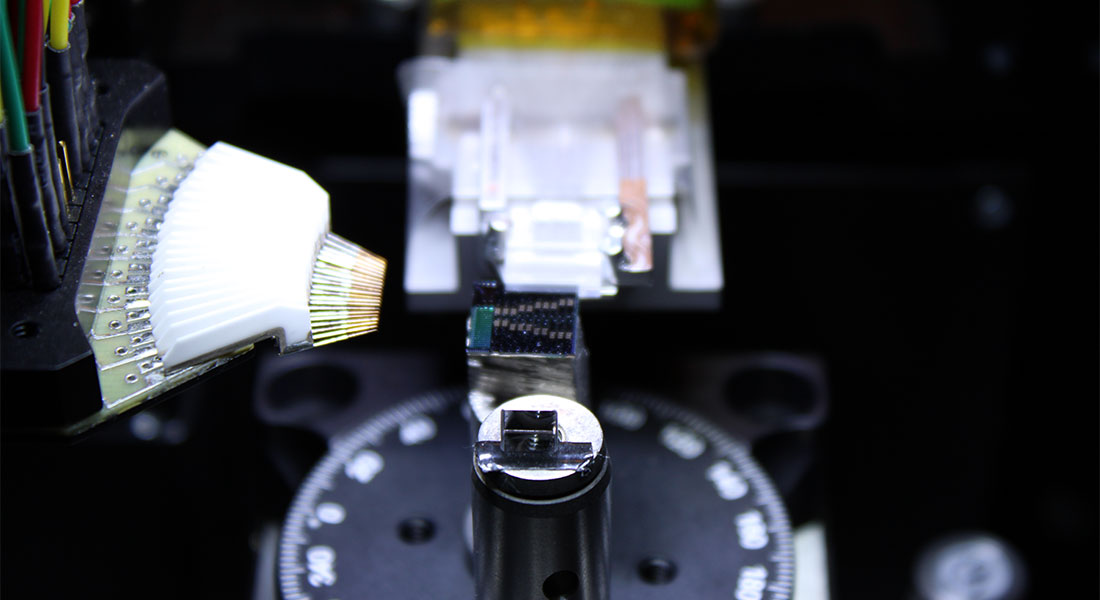
Distributed quantum computing offers a path to scaling quantum computers. One promising approach to implement such architecture relies on spin-photon interfaces: long-lived qubits that couple efficiently and coherently to photons. Color centers in silicon are promising candidates. In this project you’ll develop quantum optical & electrical characterization and control schemes on these color centers, elucidating noise processes via statistical analysis and experimental design and improving the centers’ optical and electrical properties through an understanding of the condensed matter physics involved. Through this, you will gain a deep understanding of quantum emitters in nanophotonic structures and spin qubit dynamics. This project offers a unique opportunity to work in cutting-edge semi-automated laboratories and start your journey in the quantum computing world.
Our main activities and research areas:
- Characterization of the optical properties of the color centers, using techniques such as photoluminescence, photoluminescence excitation, and spectral hole burning.
- Design, fabrication and characterization of integrated optical cavities to enhance photon emission via the Purcell effect.
- Characterization and optimization of epitaxially grown color centers, aiming to understand and mitigate the physical mechanisms and noise processes that limit the performance of integrated color centers.
- Characterization of electron and nuclear spins (Zeeman splittings, Rabi oscillations and coherence times) and their control (initialization, gate operations and readout).
- Automating measurements by programmatic control of equipment to automatically run hundreds of experiments.
What we offer:
- Hands-on experience with cryogenics, optical and microwave setups.
- Hands-on experience with cutting-edge characterization techniques of quantum emitters in integrated nanostructures.
- Develop skills in measuring and analyzing data from a novel quantum computing platform.
- Understand ensemble and single emitter physics under various conditions.
- Contribute to the development of spin-photon interfaces in silicon as a building block for distributed quantum computing.
Expected Qualifications:
Master student in Physics, Quantum Information Science or related.
Contacts:
Stefano Paesani, Photonics Pilot Line Lead, stefano.paesani@nbi.ku.dk
Peter Granum, Senior Research Scientist, peter.granum@nbi.ku.dk
Gitte Michelsen, Student Coordinator, gittem@nbi.ku.dk
How to Apply:
Please apply by email to Stefano Paesani and Peter Granum. Your application must include:
- CV
- Application letter
- Transcript